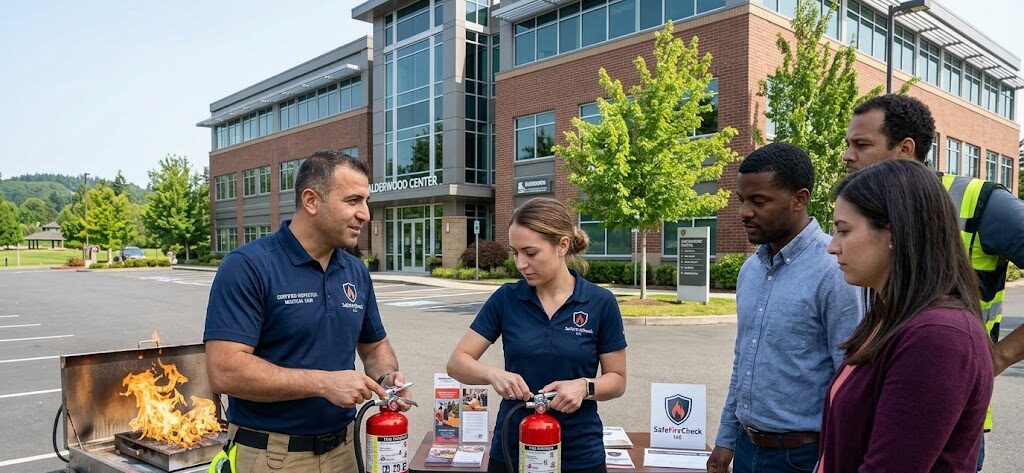
Queen Anne has a lot of buildings like this: retail or a café on the ground floor, offices or a couple of small businesses upstairs, sometimes a restaurant tucked into the corner — all under one property manager, all with their own fire extinguishers installed whenever they moved in. It’s a common setup in this neighborhood, and it creates a specific compliance problem that’s worth walking through, since it’s the kind of building we handle regularly.
The Problem: Nobody Owns the Tags
A property manager oversees the building — leases, maintenance, common areas — but not necessarily each tenant’s fire extinguisher. Every tenant has one (or several), tagged by whoever they happened to call when they moved in, if anyone. Nobody has a single record of which units are current, which are expired, or whether a restaurant kitchen even has the right class of extinguisher for a grease fire.
This usually surfaces at the worst possible time: a Fire Marshal walk-through, an insurance renewal, or after a small incident makes everyone realize nobody was tracking it.
What a Building-Wide Walkthrough Looks Like
Instead of dealing with each tenant separately, we start with the whole building. That means:
- A full inventory of every extinguisher in the building, unit by unit
- Flagging anything expired, missing, or the wrong class for the space it’s in
- Tagging and certifying what’s already compliant
- Replacing or recharging what isn’t, with pricing shown before any work happens
- One compliance report covering the entire building — not six separate paper tags scattered across six tenants
Why This Matters More in a Multi-Tenant Building
| Feature | Single-Tenant Property | Multi-Tenant Building |
| Who tracks compliance | One business owner | Property manager, coordinating across tenants who may not track it themselves |
| Tag dates | Usually aligned | Often scattered — each tenant moved in at a different time |
| Risk if missed | One business exposed | Whole building exposed at a Fire Marshal visit or insurance audit |
| What we recommend | Standard annual inspection | Building-wide walkthrough with one consolidated report |
The property manager ends up with one point of contact, one schedule, and one record to hand a Fire Marshal or an insurance adjuster — instead of chasing down whichever vendor each tenant happened to use. If you’re managing a similar building anywhere in Seattle, our commercial maintenance guide covers how we handle multi-site and multi-tenant accounts, and our Seattle service page has pricing and scheduling details specific to the city.
Need a quote for a building like this? Get an instant quote, or if you’re dealing with an upcoming Fire Marshal visit, see our same-day emergency service.