Keeping your fire extinguishers in good working order isn’t just smart—it’s required. Whether you manage an office, warehouse, apartment complex, or restaurant, regular fire extinguisher inspections help protect lives, property, and keep your business compliant with local and national fire safety codes.
📋 Inspection Schedule by Extinguisher Type (NFPA 10)
Every extinguisher needs a quick visual check once a month and a professional inspection once a year. What else it needs depends on its type:
| Type | How to recognize it | Annual inspection | 6-year maintenance | Pressure (hydrostatic) test |
|---|---|---|---|---|
| ABC dry chemical | Label says “ABC” or “Multipurpose”; has a pressure gauge. The most common type in offices and shops. | Yes | Yes | Every 12 years |
| BC dry chemical | Label says “BC”; has a pressure gauge. | Yes | Yes | Every 12 years |
| CO2 (carbon dioxide) | No pressure gauge; hard horn-shaped nozzle; heavy for its size. | Yes (weighed) | No | Every 5 years |
| Water | Silver cylinder; label says “Class A” only; has a pressure gauge. | Yes | No | Every 5 years |
| Class K (wet chemical) | Label says “Class K”; found in commercial kitchens. | Yes | No | Every 5 years |
| Clean agent (Halotron) | Label says “Clean Agent” or “Halotron”; has a pressure gauge. | Yes | Yes | Every 12 years |
The 6-year maintenance applies to rechargeable stored-pressure extinguishers (the common kind with a gauge). Disposable, non-rechargeable extinguishers (usually with a plastic valve head) don’t get a 6-year maintenance or a pressure test – they must be replaced 12 years after the manufacture date. The 6- and 12-year clocks run from the manufacture date or the last service shown on the label. Local fire code can add requirements; when in doubt, ask us below.
🔎 How to Find Your Extinguisher’s Type and Dates
- Type: read the front label. The type and its rating (for example, 2-A:10-B:C) are printed in large letters.
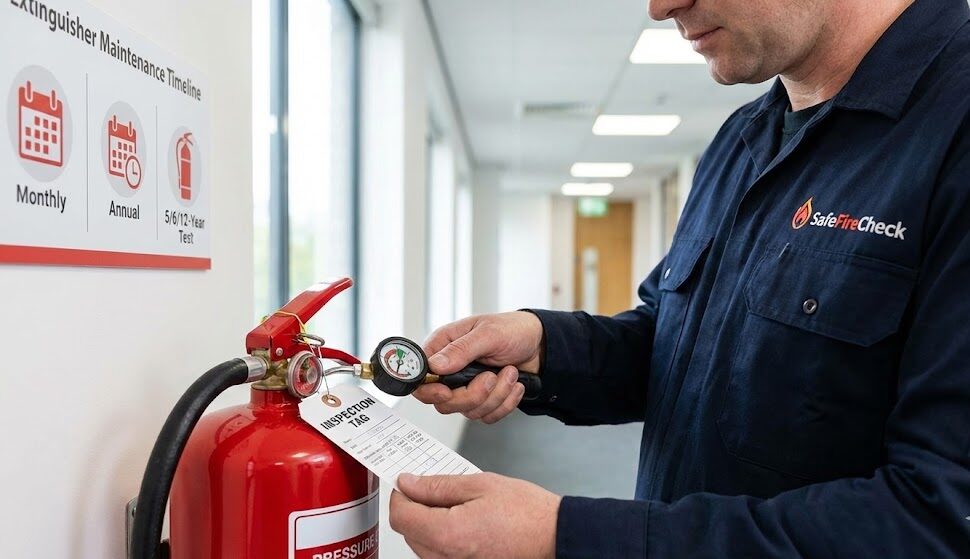
- Last annual inspection: look at the tag hanging from the neck. The last punched month and year is your last inspection.
- Manufacture and test dates: check the label or the bottom of the cylinder for the manufacture date, and look for a 6-year or hydrostatic test sticker or collar near the valve.
- Not sure? Enter what you know in the form below. Choose “I’m not sure” and we’ll tell you what it needs.
Find out when your annual inspection is due
Not sure about dates? Tell us what you have and when it was last inspected — you'll see your due date right away, and we'll follow up personally to confirm.
🔍 Monthly Visual Inspections (Required by NFPA 10)
According to the National Fire Protection Association (NFPA 10), fire extinguishers must be visually inspected once a month. This can be done by a building manager, maintenance staff, or safety coordinator. You should check:
- The extinguisher is in its designated place
- It’s easily accessible and visible
- The pressure gauge reads in the operable range
- The safety seal is intact
- No damage, corrosion, or leakage
👉 Tip: Use a checklist or inspection tag to record the date and initials of the person performing the check.
🛠 Annual Professional Inspection
Once a year, fire extinguishers must be professionally inspected by a certified technician. This inspection includes:
- External condition of the cylinder (dents, corrosion, damage)
- Hose and nozzle integrity
- Verification of the correct type and weight of extinguishing agent
- Testing the mechanical parts, labeling, and tamper seals
- Tagging with a dated certification
✅ Our team provides certified annual fire extinguisher inspections to ensure your business is fully compliant with NFPA 10. We handle the tagging, reporting, and reminders.
Failing to do this may result in fire code violations and invalid insurance claims.
⏱ Hydrostatic Testing (Every 5 or 12 Years)
Some extinguishers need pressure testing to ensure the cylinder is safe to use:
- Dry chemical extinguishers: Every 12 years
- CO₂ extinguishers: Every 5 years
- Stored pressure water or wet chemical: Every 5 years
- Cartridge-operated units: May require testing every 5 or 12 years depending on the type
This is a more in-depth test and is typically performed by a licensed service company. Separately, rechargeable stored-pressure dry chemical and clean agent extinguishers need a 6-year internal maintenance between pressure tests: the unit is emptied, inspected inside, and recharged.
🔄 Recharging & Replacement
You should recharge your fire extinguisher after any use, even partial discharge. Additionally, if an extinguisher fails inspection or testing, it must be replaced. ✅ If you need a new, fully compliant unit, we offer certified extinguisher delivery and tagging.
🏢 Why It Matters for Businesses
- 🧾 Regulatory Compliance: Avoid fines or shutdowns due to missed inspections.
- 🛡 Liability Protection: Documented inspections can protect you in case of fire incidents.
- 🔥 Real Fire Readiness: An extinguisher is only useful if it works in an emergency.
✅ Tracking all these dates can be a burden. For a simple, hands-off solution, consider our full-service fire extinguisher rental program. We manage all the inspections, maintenance, and compliance for one flat monthly fee.
✅ Schedule Your Next Inspection
If you’re in Washington and need annual fire extinguisher inspections or servicing, SafeFireCheck.com makes it easy to schedule, track, and maintain your fire safety equipment with certified technicians. Reach out to us today!
Based in Seattle? See our dedicated Seattle fire extinguisher inspection page for neighborhood-specific pricing and availability.
Have a question? Ask us.
Fire code, tags, pricing, what your building needs — ask and we'll reply personally by email or phone, usually within one business day. Prefer to text? (360) 474-7097